Most Tempe Homes Benefit
At 12.3 GPG, Tempe water sits beyond the very hard threshold, so a properly sized softener usually makes sense for daily comfort and appliance protection.
Tempe Water Filtration helps Tempe homeowners decide whether a water softener is worth installing in Arizona's very hard water. The practical answer is usually yes because Tempe water tests around 12.3 grains per gallon and hard-water scale affects fixtures, plumbing, water heaters, dishwashers, and washing machines. Our local water testing, system sizing, whole-house ion exchange softener installation, point-of-use guidance, and maintenance help match equipment to household demand instead of guessing. This guide explains the costs, benefits, downsides, and next actions before you approve a system.
At 12.3 GPG, Tempe water sits beyond the very hard threshold, so a properly sized softener usually makes sense for daily comfort and appliance protection.
Installed whole-house systems often run $1,800 to $5,500, and the choice between ion exchange, salt-free conditioning, and point-of-use treatment changes what the system actually solves.
A hardness test, household-size calculation, correct drain and bypass setup, monthly brine-tank checks, and annual resin-bed inspection keep the recommendation grounded.
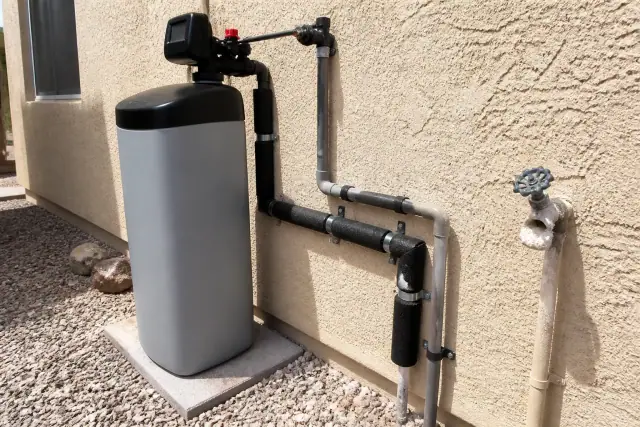
Faucet crust, shower glass film, or hazy dishes. These are visible signs that hardness minerals are reaching everyday fixtures.
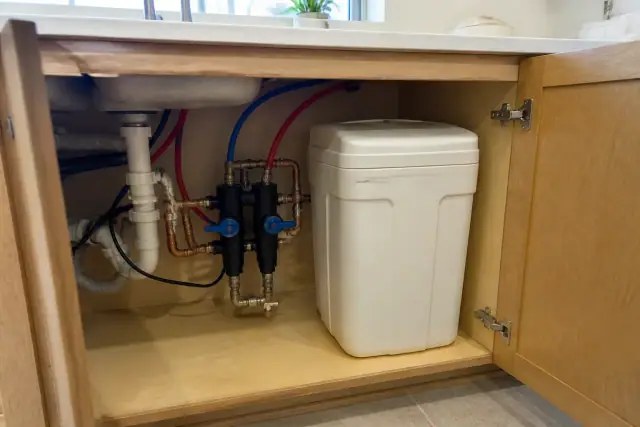
The main-line connection before the water heater, bypass valve, brine tank, and control head. This helps homeowners understand what professional installation covers.
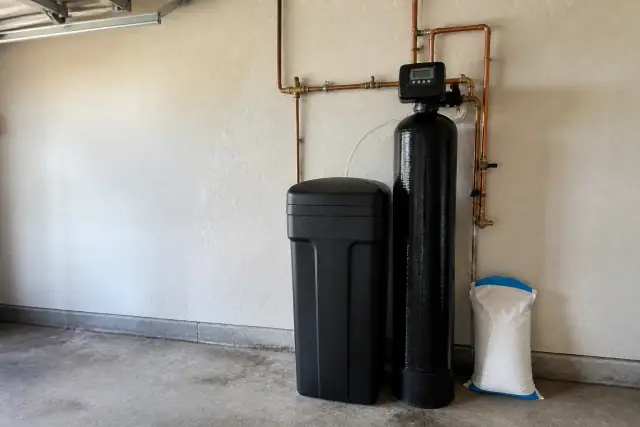
A homeowner checking solar salt or potassium chloride pellets in the brine tank. Monthly refill habits are part of keeping a softener useful over its life.
With 12.3 GPG hardness and Phoenix-area readings commonly around 200 to 250 ppm, whole-house softening is usually justified for scale, fixture film, and appliance wear.
$1,800 to $5,500 covers installed whole-house systems in the Phoenix metro, while $400 to $3,000 describes basic salt-based equipment before installation.
An affordable $1,200 to $2,000 setup can handle many single-family homes, while larger households, well-water situations, or commercial-grade equipment may push toward $10,000.
Do not choose salt-free or magnetic units when the goal is full hardness removal; they may reduce scale adhesion but leave calcium and magnesium in the water.
| Household Situation | Worth-It Signal | Recommended Action |
|---|---|---|
| Tempe municipal water | 12.3 GPG hardness is in the very hard range. | Test hardness and size a whole-house ion exchange softener. |
| Visible scale and hazy dishes | Minerals are reaching fixtures, glassware, and appliance parts. | Compare whole-house softening with point-of-use treatment. |
| Standard single-family home | Many installed systems land between $2,400 and $3,800. | Match grain rating and regeneration settings to household use. |
| DIY installation plan | Drain line sizing, bypass setup, and electrical connections can fail. | Confirm the layout before startup or schedule professional installation. |
For most Tempe households, "worth it" means the softener reduces a problem that is already happening, not a luxury upgrade. Tempe's blend of Salt River Project canal water, Central Arizona Project allocations, and groundwater carries calcium and magnesium that become scale on fixtures, inside plumbing, and on appliance components. The Department of Energy notes that softened water helps appliances run as designed and last longer. Many homeowners also notice soap rinsing more cleanly from skin and hair within days once hard-water residue is reduced.
Family size and daily water usage determine tank capacity and grain rating, so a one-size-fits-all unit can be too small or wasteful. Homes built before the 1990s with galvanized supply lines may show scale buildup faster, and Phoenix-area hardness above 200 ppm can shorten softener life without regular maintenance. For ion exchange equipment, NSF/ANSI 44 certification is a useful rating marker when the unit is properly matched to very hard water above 10+ GPG. The right answer also depends on installation access, drain-line sizing, bypass valve setup, and whether the home needs whole-house protection or point-of-use drinking-water treatment.
Most follow-up questions are about cost, maintenance, softened-water feel, and whether a softener should be paired with reverse osmosis. In Tempe, the practical path is to test hardness first, choose a properly rated ion exchange system for whole-house scale control, and consider under-sink RO only for drinking-water taste and additional dissolved solids. Homeowners should also ask about monthly salt or potassium refills, several gallons of water used during regeneration, resin-bed replacement over 10 to 15 years, and how the drain line and bypass valve will be installed.
Share your fixture scale, appliance concerns, household size, and any existing softener or RO equipment. Tempe Water Filtration tests hardness and sizes systems for local households every week, then explains whether whole-house softening or point-of-use treatment fits the property before installation.