Five Stages in Order
A true 5 stage setup moves from sediment to carbon, then through the RO membrane, a polishing post-filter, and a remineralization cartridge.
Tempe Water Filtration installs and services reverse osmosis drinking water systems for homeowners in Tempe, Maricopa County, and the greater Phoenix metro area. A 5 stage RO system uses sediment filtration, carbon filtration, membrane separation, post-filtration, and remineralization to improve tap water at the faucet. Those stages matter locally because Tempe water is commonly hard and treated with chloramine. This guide explains what each stage removes, when 5 stages is enough, and what maintenance keeps the system working.
A true 5 stage setup moves from sediment to carbon, then through the RO membrane, a polishing post-filter, and a remineralization cartridge.
Hardness, sediment, and chloramine affect how much pre-filtration the membrane needs before water reaches the faucet.
Most sediment and carbon filters need replacement every 6 to 12 months, while the membrane usually lasts 2 to 3 years with proper pre-filtration.
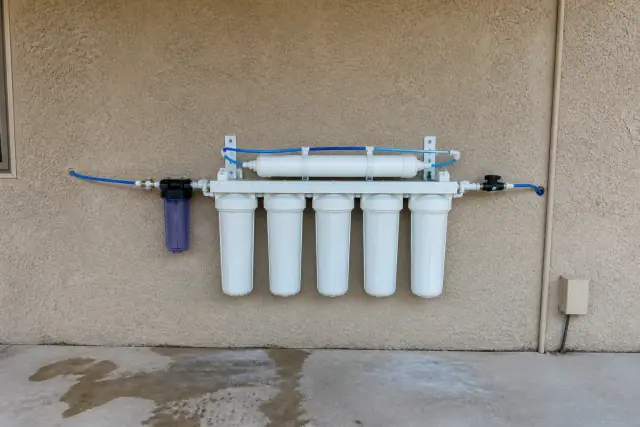
The sediment cartridge, carbon media, membrane housing, post-filter, remineralization cartridge, tank, and faucet as one connected under sink system.
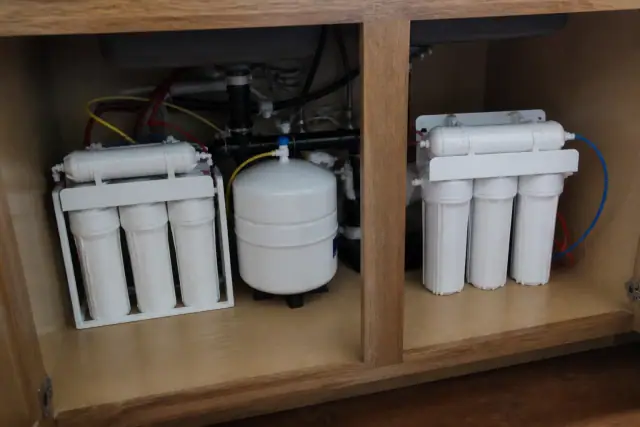
Contrast a basic sediment-carbon-membrane setup with a 5 stage design that adds final polishing and remineralization for better taste.
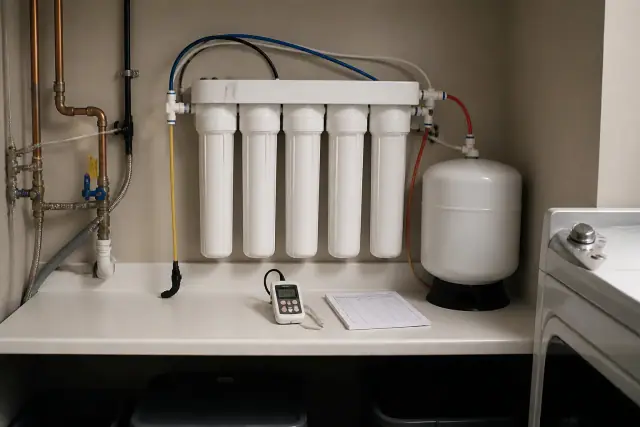
A simple service check that compares incoming TDS, filter age, membrane performance, and the household's water taste goals.
Start with an incoming TDS reading, a look at water taste and odor complaints, and the household's daily drinking water demand.
Chloramine treatment, PFAS concerns, high usage, plumbing access, and whole house flow needs can change whether 5 stages, 6 stages, or 7 stages make sense.
Replace pre-filters on schedule because fouled sediment or carbon cartridges shorten membrane life and can reduce the system's contaminant removal.
Avoid choosing a system by stage count alone; PFAS claims should match NSF/ANSI 58 and 53 testing, and chloramine reduction needs enough carbon contact time.
| RO Stage | Main Job | Why It Matters in Tempe |
|---|---|---|
| Stage 1 sediment filter | Captures sand, rust, dirt, and particles above 5 microns. | Protects downstream cartridges and the membrane from fine sediment. |
| Stage 2 carbon filtration | Reduces chlorine, chloramines, VOCs, and taste or odor compounds. | Extra carbon capacity helps with chloramine-treated municipal water. |
| Stage 3 RO membrane | Separates dissolved solids, heavy metals, most PFAS, bacteria, and viruses near 0.0001 micron. | A healthy membrane can reduce total dissolved solids by 90 to 98 percent. |
| Stage 4 post-filter | Polishes residual taste from storage, tubing, or the tank. | Improves the final water taste at the faucet. |
| Stage 5 remineralization | Adds calcium and magnesium back after membrane treatment. | Helps avoid the flat taste some households notice with straight RO water. |
A 5 stage reverse osmosis system works as a chain, not five interchangeable add-ons. The 5 micron sediment filter protects the carbon and membrane, the carbon stage reduces disinfectants and VOCs, and the membrane does the fine separation for dissolved solids, sodium, nitrates, heavy metals, most PFAS, bacteria, and viruses. Post-filtration then polishes taste from the tank or tubing, and remineralization restores calcium and magnesium so the water tastes less flat.
Most Tempe households on municipal water are well served by a maintained 5 stage system, but the best configuration still depends on source water, usage, and plumbing layout. A basic 3 stage unit may run $100 to $250, under sink 5 stage systems typically cost $150 to $600 for the unit, and quality 5 stage units commonly fall around $249 to $450 before installation. The added cost is often about $100 to $150 more than a basic unit, while 6 or 7 stage systems are usually reserved for concerns such as private wells, UV sterilization, added post-filtration, or specific microbial and radon concerns.
Homeowners usually ask whether 5 stages is enough, how often filters need replacement, and whether RO can handle PFAS and chloramines. With proper pre-filtration, an intact membrane can reduce total dissolved solids by 90 percent or more, lead and arsenic rejection commonly reaches 95 to 99 percent, and bacteria and virus removal approaches 99.99 percent because those particles are too large for the membrane. For Tempe's Salt River Project and Central Arizona Project water supply, the practical answer is to confirm incoming TDS, carbon capacity, household size, and replacement schedule before choosing the stage count.
Share your water taste concerns, household size, plumbing layout, and any TDS readings you already have. A local installer can compare those details against Tempe's hard, chloraminated water profile and recommend the right RO configuration.